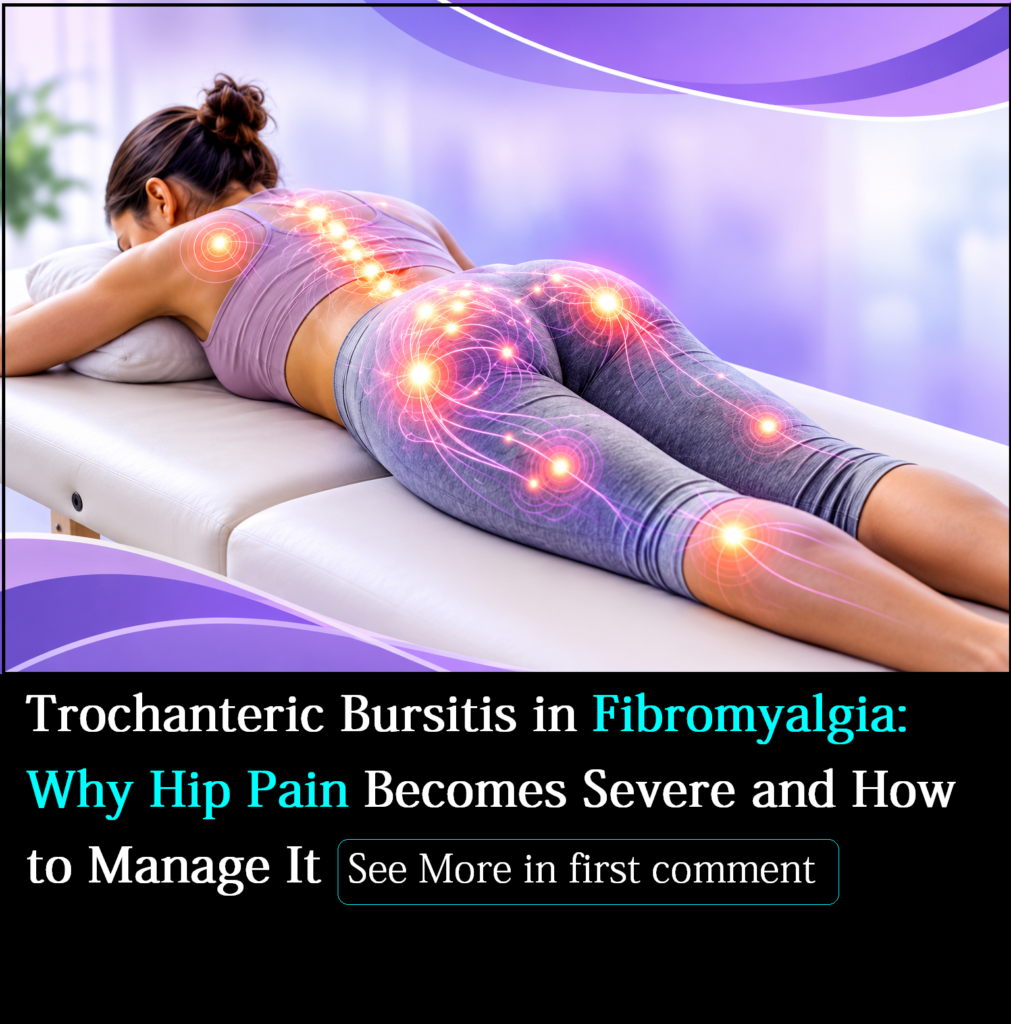
Fibromyalgia hip pain can be difficult to understand because the discomfort may feel as though it is coming directly from the hip joint, muscles, tendons, or surrounding tissues. For some people, the pain is mild and occasional. For others, it becomes a persistent problem that interferes with walking, sleeping, exercising, working, or simply finding a comfortable position.
The situation can become even more complicated when bursitis or tendinitis occurs alongside fibromyalgia. These conditions can produce similar symptoms, and their pain may overlap. Someone with fibromyalgia may therefore experience widespread sensitivity while also dealing with a localized problem affecting the hip.
Understanding the difference between fibromyalgia-related pain, bursitis, and tendinitis can make it easier to recognize symptoms and discuss appropriate treatment with a healthcare professional.
Fibromyalgia itself is a chronic condition associated with widespread pain and increased sensitivity to painful stimuli. The nervous system can process pain signals differently, causing sensations to feel stronger or last longer than might be expected from the physical problem alone.
This does not mean that hip pain in someone with fibromyalgia is “just in the head.” The pain is real. It may involve changes in how the brain and spinal cord process sensory signals, while additional problems such as bursitis, tendon irritation, muscle tension, or reduced physical activity can add another layer of discomfort.
What Does Fibromyalgia Hip Pain Feel Like?
Fibromyalgia hip pain does not always have one specific pattern. Some people describe a deep aching sensation around the outside of the hip, while others feel pain extending into the buttocks, thighs, pelvis, or lower back.
The discomfort may move from one area to another rather than remaining in one precise location. It can also become more noticeable after prolonged sitting, standing, resting, or remaining in the same position.
Common descriptions include:
- Deep or aching hip pain
- Burning or sensitive sensations
- Tenderness around the hip and buttocks
- Muscle tightness
- Stiffness after resting
- Pain that spreads toward the lower back or thighs
- Increased discomfort after physical activity
- Pain when pressure is applied to sensitive areas
- Difficulty sleeping on the painful side
- Reduced tolerance for prolonged walking or standing
One important feature of fibromyalgia is that pain intensity does not always correspond to visible tissue damage. A person may experience significant pain even when imaging does not show a major structural abnormality.
This happens because fibromyalgia involves altered pain processing. The nervous system may become more sensitive to signals that would normally be less painful.
However, this should not lead to the assumption that every episode of hip pain is caused by fibromyalgia. New, severe, or persistent hip pain deserves appropriate medical assessment because conditions affecting muscles, tendons, bursae, joints, nerves, and bones can occur in people with fibromyalgia too.
Fibromyalgia, Hip Bursitis, and Tendinitis: What Is the Difference?
Bursitis and tendinitis can sometimes resemble fibromyalgia pain, but they involve different tissues.
A bursa is a small, fluid-filled structure that helps reduce friction between tissues around a joint. Several bursae are found around the hip. One of the best-known problems is pain involving the bursa near the greater trochanter, the bony prominence on the outside of the hip.
Hip bursitis may cause:
- Pain on the outer side of the hip
- Tenderness when touching the area
- Discomfort when lying on the affected side
- Pain when walking or climbing stairs
- Increased symptoms after repetitive activity
- Pain that may extend down the outer thigh
In modern clinical terminology, lateral hip pain is often discussed under greater trochanteric pain syndrome (GTPS), which can involve the bursa as well as the tendons and other tissues around the greater trochanter. Therefore, not every case of lateral hip pain is simply isolated bursitis.
Tendinitis, or tendon-related pain, involves the structures that connect muscles to bones. Around the hip, several tendons can become painful because of repetitive loading, changes in activity, weakness, or other mechanical factors.
Tendon problems may cause pain during specific movements and may be accompanied by stiffness, weakness, or reduced function.
Fibromyalgia can complicate this picture because the nervous system may amplify pain signals from an already irritated area. A relatively localized tendon or bursal problem can therefore feel particularly intense.
Another important distinction is that fibromyalgia itself is not primarily an inflammatory disease. Its widespread pain and sensitivity are related to altered nervous-system processing rather than inflammation throughout the body. Bursitis and tendon disorders, meanwhile, can involve local tissue irritation and inflammation, although tendon pain is not always caused by inflammation alone.
That distinction matters because treatment needs to address the actual source or sources of pain rather than assuming that one diagnosis explains everything.
Why Can Fibromyalgia Make Hip Pain Feel Worse?
One of the most challenging aspects of fibromyalgia is the difference between the original physical stimulus and the way the nervous system interprets it.
Think of the nervous system as a sophisticated alarm system. Its job is to detect potentially harmful signals and alert the brain. In fibromyalgia, pain processing can become unusually sensitive. Signals that might normally produce a relatively mild sensation can be experienced as much more uncomfortable.
This is sometimes described as central sensitization or altered central pain processing.
Several factors may influence how strongly pain is experienced, including:
Poor sleep
Sleep problems are common in fibromyalgia and can affect pain sensitivity, energy, mood, and recovery. A night of poor sleep may make an already painful hip feel significantly worse the next day.
Stress
Emotional and physical stress can influence pain perception. During periods of high stress, people with fibromyalgia may notice an increase in widespread symptoms or greater sensitivity around previously painful areas.
Muscle tension
Persistent muscle tension can place additional stress on the hip and surrounding structures. It may also contribute to stiffness and reduced comfortable movement.
Reduced activity
When hip pain causes someone to stop moving, muscles can become weaker and everyday movements may become more demanding. Too much inactivity can therefore create another cycle of stiffness, weakness, and discomfort.
Overactivity
The opposite problem can also occur. Doing too much exercise or physical work during a period of relatively low activity can overload muscles and tendons. People with chronic pain often benefit from gradually increasing activity rather than alternating between complete rest and excessive activity.
This combination explains why fibromyalgia and hip pain can become a frustrating cycle. Pain can reduce movement, reduced movement can affect strength and mobility, and increased sensitivity can make ordinary activities feel harder.
Symptoms That May Suggest Bursitis or Tendon Problems
Although symptoms overlap, certain features may point toward a more localized hip condition.
For example, pain that is especially concentrated over the outside of the hip and becomes worse when lying directly on that side may occur with greater trochanteric pain syndrome.
Pain that appears consistently during particular movements or activities may also suggest involvement of muscles or tendons.
Other signs worth discussing with a healthcare professional include:
- A clearly localized painful spot
- Pain triggered by a particular movement
- New swelling or warmth
- A noticeable change in strength
- Difficulty bearing weight
- Pain that started after a significant increase in exercise
- Symptoms following an injury
- Persistent pain that does not improve with reasonable self-care
At the same time, localized symptoms do not automatically prove that bursitis or tendinitis is present. A clinical examination is often necessary to determine what structures are involved.
Imaging may sometimes be useful, particularly when clinicians need to investigate other causes of persistent hip pain. The appropriate test depends on the symptoms and examination findings.
How Is Fibromyalgia Hip Pain Treated?
Treatment for fibromyalgia hip pain usually works best when it addresses the whole person rather than focusing only on one painful spot.
There is no single treatment that works for everyone. A healthcare professional may recommend a combination of physical activity, physical therapy, sleep management, stress reduction, and medication when appropriate.
1. Gradual physical activity
Gentle, consistent movement can be helpful for many people with fibromyalgia. Walking, low-impact aerobic exercise, water-based exercise, and carefully selected strengthening exercises may improve physical function over time.
The key is progression.
Doing too much too quickly can trigger a flare or aggravate an existing tendon problem. On the other hand, avoiding movement completely may contribute to weakness and stiffness.
A gradual approach allows the body to adapt.
2. Physical therapy
Physical therapy can be particularly useful when hip pain involves weakness, altered movement patterns, reduced flexibility, or tendon-related problems.
A physical therapist may assess:
- Hip strength
- Gluteal muscle function
- Flexibility
- Walking mechanics
- Posture
- Movement patterns
- Activity tolerance
The exercise program can then be adjusted to the individual’s needs.
For someone with fibromyalgia, pacing is especially important. Exercises may need to start at a lower intensity and increase gradually according to tolerance.
3. Managing bursitis or tendon pain
When a localized hip problem is present, treatment may include temporary activity modification, physical therapy, strengthening, and strategies to reduce excessive pressure on the painful area.
For example, someone experiencing outer hip pain may need to modify activities that repeatedly compress or overload the area.
A healthcare professional can determine whether additional treatments are appropriate.
4. Sleep and stress management
Treating fibromyalgia is not only about treating pain.
Improving sleep quality and developing practical strategies for managing stress can be an important part of reducing the overall burden of symptoms.
Relaxation techniques, a consistent sleep schedule, appropriate physical activity, and behavioral approaches may be incorporated into an individual’s treatment plan.
5. Medication when appropriate
Depending on the person’s symptoms and medical history, a doctor may consider medications used for fibromyalgia or other causes of hip pain.
Medication should be individualized because different drugs have different benefits, risks, and interactions. Over-the-counter pain relievers are not appropriate for everyone, particularly for people with certain medical conditions or those taking particular medications.
For this reason, medication decisions should be discussed with a qualified healthcare professional rather than based solely on an online article.
When Should You See a Doctor About Hip Pain?
Not every episode of hip pain requires urgent medical attention, but persistent or unexplained pain should not automatically be attributed to fibromyalgia.
Seek prompt medical assessment if hip pain is severe, rapidly worsening, follows a significant injury, or makes it difficult or impossible to bear weight.
Medical attention is also important when hip pain occurs with symptoms such as fever, significant swelling, redness or warmth, unexplained weight loss, new neurological symptoms, or other unusual changes.
A clinician can look at the complete pattern rather than treating the hip pain in isolation.
This is especially important for people who already have a diagnosis of fibromyalgia. Having fibromyalgia does not prevent someone from developing arthritis, tendon disorders, bursitis, injuries, nerve problems, or other conditions.
Living With Fibromyalgia and Chronic Hip Pain
Living with chronic hip pain can affect much more than physical comfort. It can change how a person sleeps, works, exercises, socializes, and manages everyday responsibilities.
The uncertainty can be exhausting, especially when symptoms vary from one day to another.
One day, walking may feel manageable. The next day, the same activity may feel surprisingly difficult.
This variability is one reason pacing can be useful. Instead of waiting until symptoms become severe and then stopping all activity, it may be better to divide demanding tasks into smaller periods and include planned rest.
Simple adjustments can sometimes reduce unnecessary strain:
- Change positions regularly instead of remaining still for long periods.
- Increase exercise gradually.
- Avoid suddenly increasing walking or workout intensity.
- Use supportive and comfortable footwear when appropriate.
- Follow a physical therapist’s exercise recommendations.
- Pay attention to sleep quality.
- Keep track of activities that consistently trigger symptoms.
- Allow recovery time after unusually demanding activities.
These strategies do not eliminate fibromyalgia, but they can help a person develop a more predictable approach to managing symptoms.
The Bottom Line: Fibromyalgia Hip Pain Can Have More Than One Cause
Fibromyalgia hip pain can be complicated because several different mechanisms may contribute to the discomfort.
Fibromyalgia can increase pain sensitivity through changes in the way the nervous system processes sensory signals. At the same time, a person with fibromyalgia can also develop localized conditions such as bursitis or tendon-related pain.
That means persistent hip pain should not automatically be blamed on fibromyalgia.
The pain may be widespread, deep, aching, burning, or sensitive to pressure. Bursitis or greater trochanteric pain syndrome may produce more localized tenderness around the outer hip, while tendon problems may become more noticeable during specific movements or activities.
When these problems overlap, the pain can feel considerably more disruptive.
The most useful approach is usually individualized: address fibromyalgia-related pain sensitivity, maintain appropriate movement, improve strength and function gradually, reduce excessive mechanical stress on painful tissues, and seek medical evaluation when symptoms are persistent, unusual, or severe.
Understanding the difference between fibromyalgia, hip bursitis, and tendinitis can help people ask better questions, recognize changes in their symptoms, and work with healthcare professionals on an appropriate treatment plan.
Hip pain may be difficult to live with, but understanding what may be contributing to it is an important first step toward better symptom management and maintaining everyday function.
Medical disclaimer: This article is for educational purposes only and is not a substitute for diagnosis or individualized medical advice. If you have persistent, severe, or unexplained hip pain, speak with a qualified healthcare professional.